Wednesday, May 9, 2012

Native Bees in Central America

Image courtesy of Gus Harper, artist
Many people have been highlighting the importance of bees lately. Much of the news has been bad: bees disappearing, crops failing, etc. Fortunately, while climate change, shifts in agriculture, deforestation, and other factors have threatened some bee populations, it is possible for bees to make a comeback. The really good news is we can help.

Dating back to the time of the Great Pyramids, humans have practiced beekeeping, and, as Gene Kritsky writes, "in the millennia since, we have continued to study and improve upon beehive designs, making beekeeping the modern science it is today." He's right. Urban beekeeping is on the rise in the United States. Bee doctor Noah Wilson-Rich, PhD is helping city dwellers plant rooftop and other gardens to provide habitat for foraging honeybees. And yesterday CNN's Next List introduced us to Andrew Coté of Bees Without Borders, dedicated to poverty alleviation through beekeeping.

In Nicaragua, we're alleviating poverty and protecting biodiversity by reviving the ancient tradition of meliponiculture, the management of Melipona and Trigona bees, as practiced by the Mayans. Wild bees, which nest in hollow trees and ground cavities, are brought home by beekeepers who maintain healthy bee colonies and harvest honey and other hive products.

Our intern, Sarah Rudeen, is headed to San Cristobal de las Casas in Chiapas, Mexico to join Nicaraguan biologists at a conference and workshop organized by the Mexican university Eco-Sur to learn about native beekeeping and commercializing bee and honey products for the benefit of communities. Not only does the honey provide a valuable source of calories in a an area where food security is not always completely stable, it provides a means of income for the beekeeper and his or her family. In addition, bees provide valuable ecosystem services.

Native bees maintain year-round pollination services in dry tropical forests, like those found in Nicaragua. While the nesting and breeding seasons of large bees match the blooming seasons in dry forests, small bees visit and pollinate flowers throughout the year. Bees pollinate valuable cash crops in rural Nicaragua, and provide an estimated 50% of pollination in dry forests. We might say the importance of bees to the biodiversity of Central America is immeasurable, but we're actually working on ways to quantify the value of the ecosystem services bees (and other pollinators, like bats) provide.

When our newly trained team of meliponiculturists return to Nicaragua, armed with information from Mexican beekeepers and entomologists, they will revive a rich cultural history and help individuals and local cooperatives save local ecosystems and launch new business ventures to economically empower rural communities.
We are grateful to the Turner Foundation for their support of our beekeeping program. 
If you are interested, you can also make a contribution to our efforts to restore the ancient practice of meliponiculture for poverty alleviation and biodiversity conservation.

Monday, April 30, 2012

Lessons learned from the Yellow-naped Amazon

Yesterday we took part in the Parrot Care Project and Cage xChange event at Omar's Exotic Birds in Santa Monica.

Here's what we shared with the people in attendance about our Yellow-Naped Amazon Parrot Conservation Program:

As an environmental conservation organization dedicated to habitat restoration and community empowerment in Nicaragua, we've been studying the Yellow-Naped Amazon parrot for four years. We're here today to share with you what the Yellow-Naped Amazon has taught us about the needs of parrots everywhere.

One of the reasons we study the Yellow-Naped Amazon Parrot is because a healthy parrot population is an excellent sign of a mature and healthy forest. Forest health is important to Paso Pacifico because we are dedicated to biodiversity conservation from ridge to reef and deforestation is common in the rural areas where we work. The reasons for deforestation are rapid tourism development, road construction, commercial forestry, agricultural expansion, and wildfires. The results of deforestation are less canopy for tree-dwelling species like sloths and spider monkeys, and fewer foraging, roosting, and nesting spots for the Yellow-Naped Amazon parrot.

In fact, one of the first things we learned in studying the Yellow-Napes is that, unfortunately there are so few left in coastal Nicaragua, that it is difficult to come up with a reliable population estimate. This tells us that the work we're doing is important and that the Central American cousins of the parrots you have at home need our help. Two species of parrot who used to live and thrive in the forests of Nicaragua are now locally extinct, the Scarlet Macaw and the Great Green Macaw. We do not want to see the Yellow-Naped Amazon disappear from Central American forests, too.

Ostional school mural by Lezamón
In their native home -- which spans the mountain and coastal forests from southern Mexico into Costa Rica -- Yellow-Napes have taught us just what the parrot vets and nutritionists and behavioralists are talking about today: parrots are intelligent and social birds with complex needs.

We work with wildlife biologists and ornithologists who specialize in parrots, foresters and ecologists who specialize in tropical forestry, graduate students eager to learn more, and citizen scientists who help us monitor birds and gather data in the field.

We have observed Yellow-napes as they travel from the moist forests of Costa Rica during rainy season to the dry forests of Nicaragua during the dry season. Parrots travel from forest to forest as the seasons change to get more fruit. In the rainy season, moist forests are more productive and offer more fruit. In the dry season, dry forests are more productive and offer more fruit. Watching the Yellow-Napes travel from forest to forest to forage for food, we've learned just what Tiffany explained about parrot nutrition: these birds need variety in their diets.

Parrots don't just need healthy areas of forest with fruit-bearing trees; they need forested corridors allowing them to travel from dry forests to moist. In other words, parrots travel a lot. Just as Mira Tweti is trying to emphasize with her Cage Xchange program: parrots need a great deal of room to move.

In order to know where to go to find these fruit-rich forests, parrots need to talk to each other. Parrots require dense forests with trees large enough to support communal roosting. It is during communal roosting that individual parrots and parrot flocks share information with each other about the best locations for finding food. What we've learned from watching Yellow-napes communicating during communal roosting, is just what Tiffany and Hillary have explained: parrots are intelligent and social; they need families; they need to communicate with others.

In addition to requiring both moist and dry forests, healthy forest corridors, a variety of fruit-bearing trees, and communal roosting trees, parrots require specific kinds of trees for nesting. Nesting sites are crucial for threatened birds like the Yellow-Naped Amazon, as we protect existing birds and work to increase the overall population.

Parrots require tall trees for nesting or large, mature trees which form natural cavities, where the parrots like to lay their eggs. Without suitable nesting sites, parrots don't nest, and for a species which has only two eggs per clutch, this is highly problematic in terms of ensuring a healthy population.

Just as this campaign is dedicated to helping you keep your parrots healthy by providing larger homes for your birds, we are helping these endangered parrots rebuild healthy populations by expanding the size of their home through reforestation. In the past five years, we have planted over 500,000 trees, making sure to plant the species of trees parrots prefer for foraging, roosting, and nesting.

In healthy forests, parrots face yet another threat: poachers who can shimmy up the trunks of even the tallest trees to take parrot eggs right from their nests. Poachers usually sell parrot eggs and hatched parrots into the illegal pet trade, which leaves even fewer parrots in the wild. What we have learned from observing Yellow-Napes and the devastating effects of poaching is the importance of adopting parrots from responsible people like Omar, who rescue birds and help them find better homes.

To increase the number of successful parrot nests, we do two things: we build parrot nesting boxes and we incentivize people to find and protect parrot nests.

Parrot nesting boxes are constructed of PVC pipes which are assembled to mimic the natural cavities of tree trunks preferred by parrots. Once assembled, the nest boxes are lined with wood chips and camouflaged with paint, branches, and leaves. We pay former poachers, who have learned about the importance of protecting this threatened species, to shimmy high up into the trees and secure these nest boxes far from predators.

Our incentive program for protecting parrots makes cash awards to people who observe and report a parrot nest, share the nest's location, and promise to help protect the nest from poachers and other predators. Each found nest earns the finder $20, which is almost two week's salary in rural Nicaragua. Once the eggs have hatched, and the young parrots have left the nest for the forest, we pay $40 per Yellow-Naped Amazon fledgling. Direct payments for conservation achieve excellent results, and just this nesting season, we've seen four nests reported and eight fledglings successfully leave their nests. That means more of your pet parrots' distant cousins are living free in the forest.

Slingshot-binocular exchange partners:
Optics for the Tropics
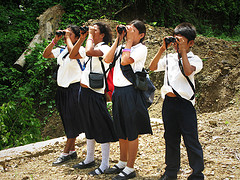
Another way we're helping the Yellow-Naped Amazon make a comeback is by raising awareness through educational events like this. We teach Nicaraguan children about their parrot neighbors and their importance in the world. In rural areas, many children play with slingshots and will shoot the birds out of trees. To tackle this problem, we host slingshot amnesty days, where each kid who turns in a slingshot and signs a pledge to become a friend to parrots receives a brand new pair of binoculars. These kids, who have come to love their parrot neighbors and are learning more about the birds and the forests they call home, would undoubtedly be excited to know there are people here in Santa Monica learning about them and the place where they live.

What we have learned from observing the Yellow-Napes is that expanding the area they call home, ensuring they can gather to communicate, providing access to crucial foraging sites and fruit-bearing trees, and creating a culture of conservation is helping the parrots. We are grateful that you are here to learn how to provide the right habitat and diet for your bird, and to understand how to communicate with your bird. We are thankful to be included at an event like this and pleased to conect with so many other parrot experts and parrot lovers. We hope you will help us as we work to study and save your birds' cousins in Central America.

Thursday, April 26, 2012

Internship: Surfing and Ocean Conservation

Photo courtesy of The Barrio Planta Project via Yaosca Jimenez
Over the past several years, more and more tourists have been finding their way to the Pacific Coast of Nicaragua for the waves. Recently, local Nicaraguans from fishing communities have also adopted the sport with a passion. In July 2012 Nicaragua will host the ISA World Masters Surfing Championship.

With the right knowledge, tools, and organizational support, these young locals may be empowered to lead the ocean conservation movement in their communities.

However there are many challenges, for both the young local surfers and the oceans. Local surfers face difficulties due to lack of education (more than half of local surfers surveyed had not finished high school), economic disadvantages, and inexperience at leadership. The oceans and coasts of Nicaragua are being heavily impacted by poorly planned coastal development, river contamination, plastic debris, and human disturbance of key wildlife habitat (e.g. - turtle nesting beaches and reefs).

In 2010, Paso Pacifico began a program to empower local surfing youth in the San Juan del Sur municipality with training and tools to organize and develop leadership as ocean stewards. As we continue to develop this program we seek an intern to support Paso Pacifico's staff in Nicaragua in activities that support the goal of this project.

Internship duties will include, but are not limited to: 
  • planning, organizing and facilitating workshops on ocean conservation issues, organizational development, leadership
  • coordinating with San Juan del Sur Association to ensure their participation in key surfing and conservation events 
  • providing leadership training
  • planning, promoting and coordinating surf group clean-up events and other ocean protection activities
  • reaching out to the foreign surfing community in Nicaragua and beyond to gain support (moral, logistical, financial) for program goals
  • recruiting new surfers to participate in events and workshops
  • sharing media (photos, written stories) about project with Nicaraguan partners and internationally connecting the local surfing assaciation with other international surf and environment advocacy groups
  • representing Paso Pacifico and our mission in a positive manner before the community
  • coordinating activities with Paso Pacifico staff in Managua and/or rural offices
  • participating in the organization of press conferences
  • acting as an ambassador for ocean conservation and a healthy lifestyle
  • surfing 

Required Skills: 
  • fluent in Spanish
  • works well independently
  • passion for ocean conservation 
  • leadership and public speaking skills
  • good writing skills
  • flexible
  • hard working 

Desirable Qualifications: 
  • surfing photography
  • social media
  • Bachelors degree in Environmental or Social sciences
  • experience in organizational leadership (running meetings) 
  • experienced driver 

Intern must be willing to travel, lodge, and dine in conditions typical for the rural developing tropics. Intern will be required to meet guidelines set out in Paso Pacifico internship agreement. Intern will report to Nicaragua Country Director and will coordinate activities with Paso Pacifico local partners including the Nicaraguan Surf Association and the San Juan del Sur Surf Association. Intern must be flexible in job duties, providing at times support to other Paso Pacifico conservation programs and will also be asked to participate in nation-wide Coastal Clean-up event.

How to Apply:
Please submit resume and cover letter to info@pasopacifico.org with subject line "Surfing and Ocean Conservation Internship".

Start and completion dates for internship may be flexible.


This opportunity was originally posted at Idealist.org.

Friday, April 20, 2012

Earth Day 2012: Help Us Plant One Thousand Trees

The Pacific slope of Nicaragua – home to threatened mangroves, endangered sea turtles, and yellow-naped Amazon parrots – is one of the most biodiverse regions in the world. As in many impoverished places, the pervasiveness of rural poverty can generate tension between locals and conservationists.

Since 2005, Paso Pacífico has worked to mitigate climate change, restore migratory corridors, and increase prosperity from ridge to reef. Our science-based and community-driven methods have produced great results in terms of ecological understanding and environmental restoration across the Paso del Istmo biological corridor where we work.

We are extremely pleased with the progress we have made in changing hearts and minds to respect a culture of conservation, but there is still work to be done.

After rangers explained that hunting was restricted in our reserves, last week hunters set fire to the forest in retaliation. This incident, though isolated and rare, highlights the need for continued environmental education, as well as the importance of our longstanding commitment to economic development and conflict resolution.

We will continue our integrative programs, but our most pressing need now is to restore the connectivity of wildlife habitat crucial for endangered spider monkeys and nearly extinct jaguars. Help us replace the trees destroyed in the fire.

  • Plant Native Trees – $10 will plant 10 native saplings, providing clean air and water and wildlife habitat.
  • Sponsor a Junior Ranger – $50 will help a young person become a leader as we develop the next generation of biodiversity stewards in coastal Nicaragua. 
  • Launch an Enviropreneur – $250 will provide specialized training and small business loans for small enterprise in the fields of sustainable farming, geotourism, and ecosystem services.
Help us promote biodiversity, entrepreneurship, and conservation. Please visit our website to learn more, like us on Facebook, follow us on Twitter or Pinterest, or donate today to help us plant a seed of change.

Tuesday, April 17, 2012

80,000 Acres Added to Maya Biosphere Reserve

More protected habitat is a "good deal for jaguar, puma, ocelot, margay, tapir, howler monkey, spider monkey, scarlet macaw, ocellated turkey, harpy eagle, and other endangered wildlife" in Guatemala.

Read more about the expansion of the Maya Biosphere Reserve in the Daily Green.

Friday, April 13, 2012

Giving parrots elbow room


Parrots make headlines in today's LA Times:
Tweti's nonprofit Parrot Care Project and Cage xChange Campaign will begin this month at a Santa Monica exotic bird shop where free veterinary exams will be available and experts will be on hand to discuss avian nutrition, how to choose the right cage and how to equip it with toys.
We'll be at Omar's in Santa Monica on Saturday, April 29th for the Parrot Care Project and Cage xChange event. We'll talk about how what we've learned from four years of observing the Yellow-naped Amazon in Nicaragua can help parrot owners in the United States.

Thursday, March 22, 2012

Madagascar's Unique Wildlife Populations

NBCNews Science:
The mysteriously rich diversity of life on the isle of Madagascar might have arrived there in part on "floating islands" carried by ocean currents, researchers now say.

Madagascar, the world's fourth-largest island, is the sole home to a wide variety of animal species, most of which are thought to have reached Madagascar after plate tectonics separated it from Africa and other continents.

...

But not all scientists have been convinced by this theory.

"There has been a great debate about rafting over at least the past 50 years," Samonds said. "While many authors have argued that dispersal events by terrestrial, land-dwelling animals across great distances of water are virtually impossible, others have argued that even unlikely events are certain to occur if the time elapsed is long enough, and that prevailing ocean currents could have aided these journeys."